

Traveling and Moving With Your Dog#
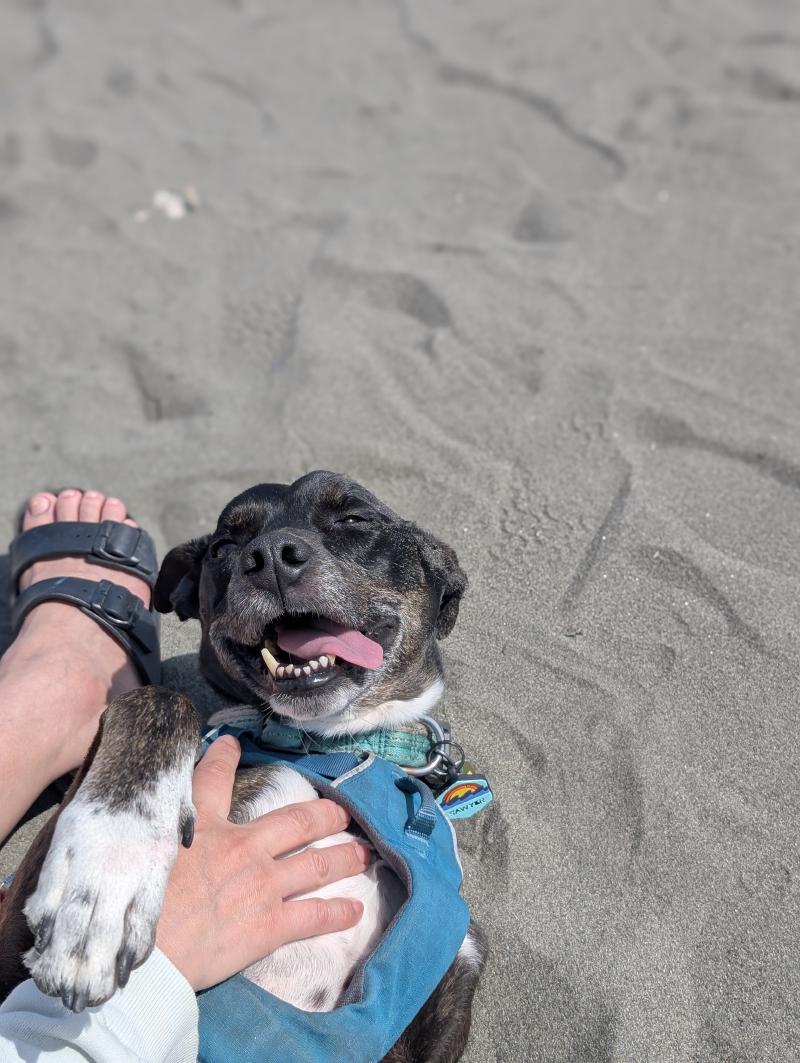
This post is long overdue, and honestly, I should have written this a while back. Getting your Spouse Visa and Residence Card is one battle, but what if you are wanting to move with your dog/cat/animal friend? To be frank, this was probably the most difficult and stressful part of the move. There are added costs, months of waiting, and uknowns on whether you’ll get your documents approved on time for your flight (i.e. you might have to reschedule your flight). Its a lot. It’s also a huge decision on whether you want to bring your animal friend to a foreign country or not. I won’t get into the reasons for or against, and honestly there shouldn’t be any judgement on you if you decide or not decide to bring your animal friend with you.
でも - if you do decide to bring your pet with you (like I did), I’ll layout the process we took to get our dog (see photo above) to Japan.
Planning: Flowchart and Timelines#
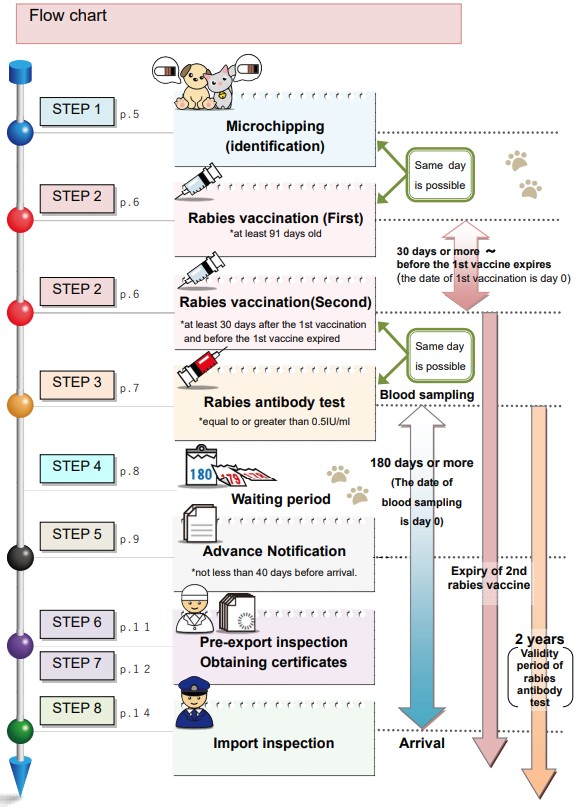
The flowchart above is taken directly from The Animal Quarantine Service of Japan. This applies for dogs. There are other guides for other animals, but I believe that the guide for cats and dogs are fairly similar. However, you should check out the site for specifics for your pet.
Just note that there is a 180-day (or more) waiting period between the Rabies antibody (or FAVN) test and the actual arrival/inspection at Animal Quarantine Services in Japan. Remember:
- the 180 day waiting periods starts on the day your vet performs the blood draw for the Rabies antibody FAVN test
We’ll get into a few specfics for the vet and what not later in this post, but I want to start off with the first steps for your animal. I traveled with my dog, so I can only speak from that perspective.
For dogs, its important to have the following for your pet:
- Microchip
- Rabies vaccinations are up-to-date
Microchip#
For most pets in the United States, microchipping is a fairly standard practice. If your pet isn’t microchipped, you should go out and do that. One thing to note for your pet microchip:
Ensure your pet’s microchip meets the ISO 11784 and 11785 standard: 15-digits microchip code, containing only numbers
Per the guide the microchip must be implanted before the 1st rabies vaccination and/or the chip and the rabies shot can be performed on the same day.
With our dog, he was a rescue and he was already microchipped.
Rabies Vacinnations#
This is also a pretty standard vaccination for pets in the US. Per the guide:
- your dog or cat must be at least 91 days old at the time for the vaccination
- the 2nd vaccination must be at least 30 days after the first vaccination
Basically, as long as your dog’s medical records show two separate rabies vaccinations that are at least 30 days apart, and the 2nd vaccination is still valid, you should meet this requirment.
Ensure this is all documented in your pet’s health records with your vet.
Finding a USDA APPROVED Veterinarian and the FAVN Report/Test#
One thing you absolutely need to ensure is that the vet you are using to obtain your pet’s health certificate, approvals, and to administer the FAVN/Rabies test is a USDA-Accredited Veterinarian.
For me, my local vet was great but they were not on the USDA-Accredited list. I could go to my local vet for all my other stuff though: vaccinations (including Rabies), check ups, etc. However, to start the paperwork and the process for traveling abroad, we had to use the link above to find a vet near us that is accredited.
We found a vet using the link and contacted them to set up the initial steps and coordination. From there, they were able to hand walk us through the rest of the process to obtain my pet’s health certificate for travel.
FAVN Report#
Once we had the USDA-accredited vet lined up, they went over our pet’s health record to ensure they met the microchip/Rabies vaccination requirements. Once that was reviewed, we could begin the process for obtaining the FAVN report. This report is a Rabies antibody test. The interesting thing about this test is that it can only be tested at certain labs in the United States. I believe its only two locations:
- Kansas State University Rabies Lab (this is where my test was sent)
- DoD Veterinary Lab (typically reserved for US Service Members traveling abroad on military orders)
Essentially a blood sample was drawn from our USDA-accredited vet in Virginia and then shipped to the Kansas State University Rabies Lab. After several weeks, your vet should receive the test results.
180 Days - The Long Wait#
The day the blood is drawn for the FAVN report is when the clock starts on your 180 waiting period. You should try to set your travel plans for sometime after the 180 day waiting period. If you arrive before the 180 days, then your pet will have to spend the remainder of the time (or longer) in a detention quaratine location.
HOWEVER - there is a possibility that there will not be any space for your pet in the detention quarantine in Japan. We were battling with this potential issue of flying to Japan before the 180 day period, but when we asked the Animal Quarantine Service (AQS) at Haneda Airport, they told us that they have very limited availability and that if there was no space, they would send the pet back to the United States on our expense. That was something we definitely did not want to do - so we kept our plans of arriving after the 180 period.
Animal Quarantine Service (AQS) Advance Notification - 40 Days Before Arrival#
Per the Guide to importing dogs and cats into Japan from Non-Designated Regions from the Japan AQS:
The importer must submit a “Notification” to the Animal Quarantine Service office at the expected port of entry not less that 40 days before arrival in Japan.
This notification can also be an email, so that is very convenient. In the guide above, there is a list of phone numbers and emails for the AQS locations at most of the major airports in Japan. For this notificaiton we had to fill out and email the Notification form for Dogs. The form is pretty straight forward, so fill out the information required for your flight, dog, etc.
I had the form filled out and set a calendar reminder to send the form 40 days prior to my flight so I would not forget.
10 Days prior to flight: Pre-Export Clinical Inspection#
If you weren’t stressed out enough already - buckle up. This last 10 days will be fairly intense. 10 days prior to the flight, we had to schedule a pre-export health inpsection for our dog. This is a last check up with your USDA-accredited bet to ensure your pet is good to go for travel. This is the point where this vet will submit the health certificate to the USDA to be officially endorsed by this government agency.
Now, as we all know, government bureaucracy can be….something. Especially if there is a shutdown, government cuts, etc…this can delay this approval. You need these endorsed health certificates in order to officially import your animal. I was flying out on a Monday and I think I got my health certificate endorsed 3 days prior to my flight. On Reddit, I read horror stories were it took weeks and people had to delay their flights. Yikes.
I want to stress that there isn’t any real way to expedite this process. Our vet made it know multiple times that they have no control over this process and that they were all at the mercy of this one USDA approver.
Once I got the approved health certs (they were available online once approved), I printed out copies of the approved health certificates and the FAVN report. For good measure, I also had a digital copy of my dog’s entire health record from the vet just to be on the safe sid - but didn’t need it.
Hopefully you’ll have a less stress time than others!!
Airport Departure#
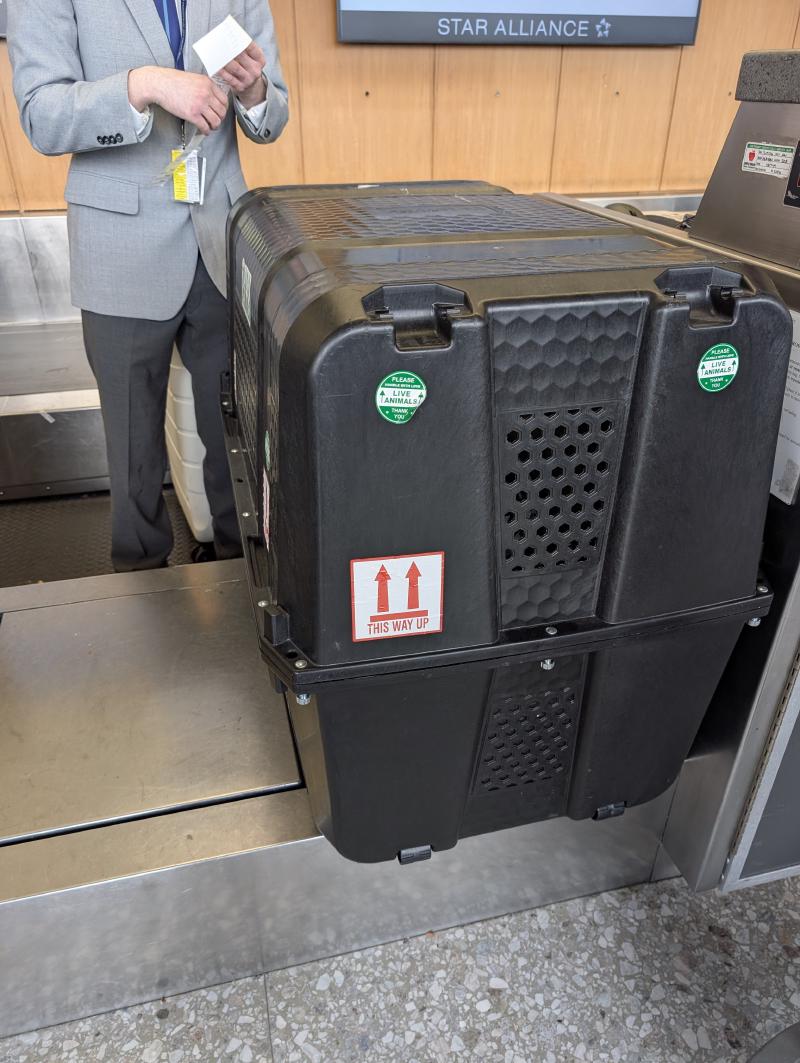
Contact your airline prior to the flight to see what the requirements are for traveling with your pet. Small animals may be able to ride in the cabin with you, while others will have to ride with cargo. My dog had to do the latter. For our flight we had to have the following set up for our dog:
Airline approved kennel - you can search for these on Amazon, PetSmart, PetCo, etc. It has to be big enough to allow your animal space to stand, sit, lay down, and turn around so keep that in mind.
Attachable food/water tray - I ordered one on Amazon that will attach to the cage door of my dog’s kennel.
Live Animal and This Side Up Stickers - there are kits that come with all of this stuff, so make sure there are a couple of these stickers on each of the sides of the kennel
Urine/Water absorbant mat or pad - Its a long flight so there is the chance your animal make get nervous and urinate in the crate. You dont want to pick up an animal like that, so having a mat or pad that can absorb that stuff may be handy
You will also have to pay applicable fees/taxes for shipping and importing your dog. I think we had to pay close to $600 to ship our dog on the plane. It is what it is I suppose.
Aiport Arrival to Japan#
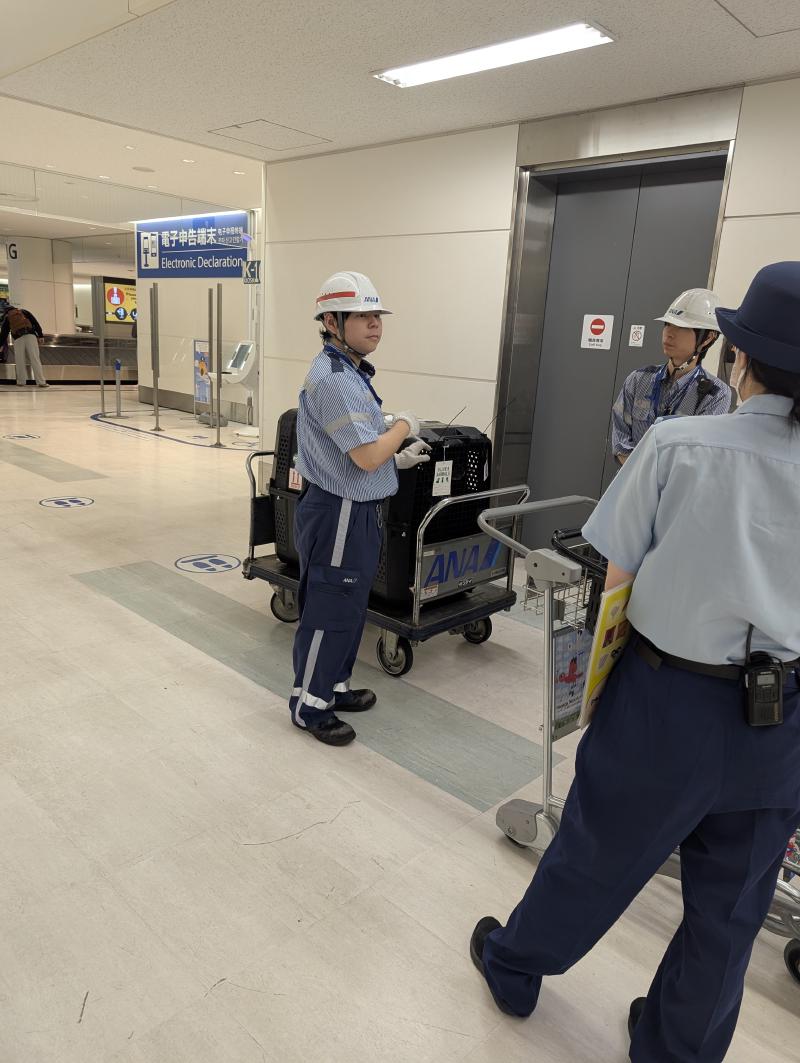
Upon arrival, you will meet with your animal as your collect your luggage. Don’t worry - your pet won’t arrive on the baggage carousel! Once you’ve collected your luggage and animal, you’ll head to the the AQS for inspection. They’ll review the paperwork and use a scanner to make sure the microchip can be read. I believe we were in and out of AQS in less than 30 minutes since all of our stuff was in line. There is the possibility it could take longer, so exercise patience as much as you can.
Bonus: Dog Taxi from the Airport#

Hopefully you’ll have transportation for you, your family, your luggage, and your dog! However, we do not have a car in Japan and my wife’s uncle couldn’t secure a large enough vehicle in time for our arrival. Well, fret not - there are services in Japan that can pick you up, have enough room for your luggage and dog, and drop you off at your location! Mind you - there isn’t that much space in his car so you probably won’t fit a ton of people, but we were able to fit the luggage, the dog, kennel, my wife and I in the car.
You can do a quick search online for “Pet Taxi Japan” and turn up multiple results. We utilized the following service:
Yakou Dog House - Pet Taxi Service
We found his rates to be very reasonable. Our driver, Izu, was very accomodating, friendly and fair.
Resources and Links#
- Guide to importing dogs and cats into Japan from Non-Designated Regions from the Japan AQS
- The Animal Quarantine Service of Japan
- a USDA-Accredited Veterinarian
- Notification form for Dogs
- Yakou Dog House - Pet Taxi Service
- Japan Handbook - Bring Your Pet to Japan Checklist : Another blog post, but they do a really good job of summarizing each of the steps and it basically follows the flowchart above
Misspelled Words#
Its been a while since I last updated the blog as I have been adjusting to my new life out here in Japan. Its also somewhat late and I know I have a ton of misspelled words in this post - I’ll eventually clean it up!